As Climate Action Africa commemorates Africa Day on May 25, 2026, this story reflects the African Union’s shared commitment: “Assuring Sustainable Water Availability and Safe Sanitation Systems to Achieve the Goals of Agenda 2063.” In Rwanda, that commitment is already taking shape through stronger water information systems, inclusive innovation, and local leadership.
Supported by Global Affairs Canada through Climate Action Africa (CAA), this initiative has contributed to strengthening the Rwanda Water Resources Board (RWB)’s capacities to manage hydrological data, expanded monitoring readiness through the Aquarius Hydro-MIS upgrade, introducing a citizen-based soil erosion monitoring tool that engaged communities across four districts. Together, these efforts show how investments in water security can advance climate resilience, public health, and sustainable development across Africa.
From Data to Decisions: Strengthening Water and Climate Resilience in Rwanda
Submitted by the Rwanda Water Resources Board Team
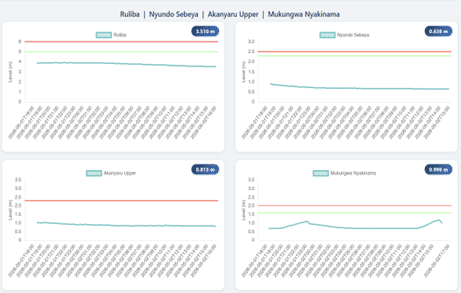
Rwanda is highly vulnerable to flash floods. Although the country has a hydrological database, local leaders have not always had access to tailored information, such as flood thresholds for specific locations. As the number of monitoring stations increased in response to the devastating floods of May 2023, the database used by the Rwanda Water Resources Board could no longer accommodate all monitored points. With an upgrade to the Aquarius large-capacity hydro-database, along with flood marks and thresholds co-designed with communities, Rwanda is building a stronger data-driven foundation for climate resilience—one in which community knowledge, modern hydrological systems, and institutional collaboration come together.
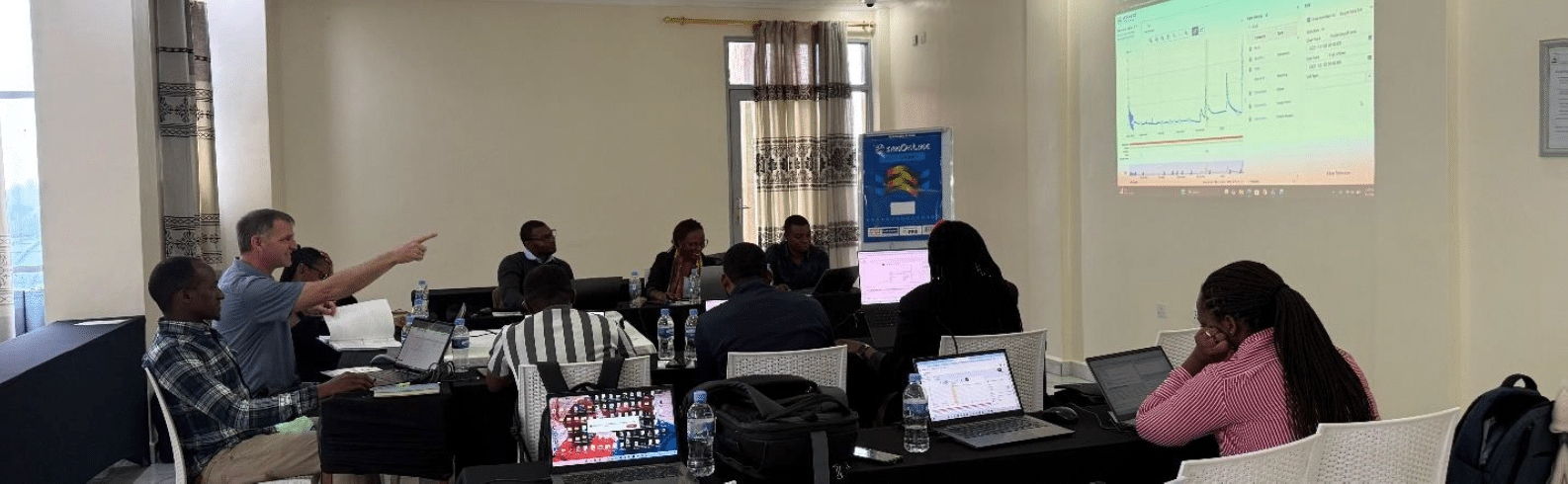
Through the CAA Technical Assistance Initiative, the Rwanda Water Resources Board (RWB) significantly strengthened its Water Management Information System. A key milestone was upgrading the Aquarius Hydro-MIS from a medium to a large system capable of handling over 1,000 hydrometric stations, dramatically expanding national monitoring capacity and improving readiness for climate-informed decision-making.
Through this Government of Canada funded technical assistance, the Canadian, British Columbia-based MEK & Environmental Inc. expert team was deployed to help strengthen climate data systems, while integrating gender equality and social inclusion to support sustainable, climate-resilient development.
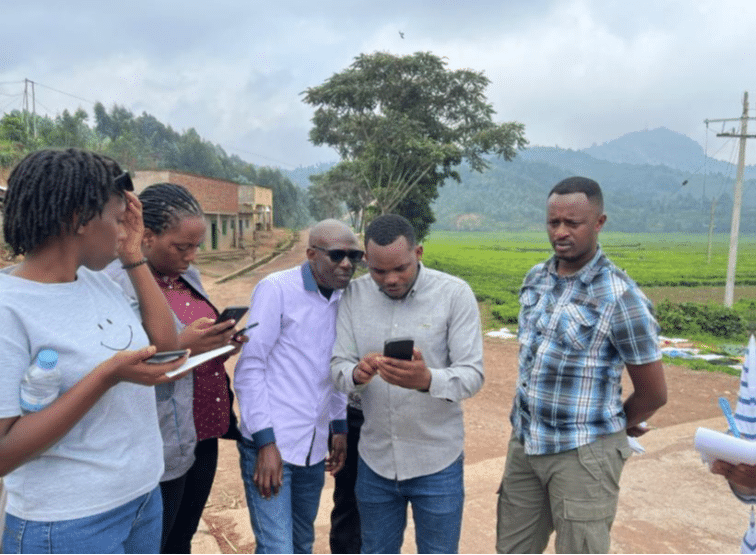
Other early flood warning and citizen-centered RWB projects have demonstrated that data becomes meaningful when it reaches people. For example, by training farmers, validating flood thresholds using historical data and field observations, and broadcasting climate information through radio, the initiative Enhancing Climate Change Resilience in East Africa (ECREA) has helped communities better anticipate floods, manage soil erosion, and adapt agricultural practices. This collaborative initiative focused on strengthening climate resilience through innovative research, policy interventions, and community-driven solutions. More information here.
Testimonies from village leaders, like Jean Pierre BUCUMI from Rusizi District from the Rusayo Village, show the real impact of this work: access to weather and flood information is helping communities take anticipatory action. They are better able to understand risks, prepare for them, and plan accordingly. At the heart of this change is stronger data management.
“At the Rwanda Water Resources Board, the introduction of Aquarius time series has transformed how we manage hydrological data… We now have a reliable system to store, validate, and analyze data efficiently… It simplifies daily work, strengthens collaboration, and helps us deliver more accurate information for water resources planning and decision-making in Rwanda.”— Jackline UWIMBABAZI, Hydro-database Specialist, RWB
Rwanda is undergoing a critical shift: from fragmented, manual data handling to an integrated, reliable system that supports both experts and field technicians. This transformation is not only technical; it is also institutional, enabling faster workflows, stronger collaboration, and more trusted data.
“Since the website update and the upgrade to the new Aquarius system, we can finally scale up our groundwater monitoring. Where we used to be limited in the number of stations we could manage, we can now add roughly 20 more stations and deliver additional services in a very short time. It’s hard to believe how quickly the issue was fixed—this upgrade is already changing what we can do day to day.” Bernard MUSANA, Head of Knowledge and Forecasting Hub, RWB.
Together, the Climate Action Africa initiative and projects such as ECREA show that resilience is built on two pillars: strong systems, such as Aquarius, that ensure high-quality data; and strong communities that can use that data to take effective climate action. As Rwanda continues to scale these efforts, the link between hydrometric data, flood thresholds, and farmer decision-making will only grow stronger, turning information into action, and action into resilience.
About the Rwanda Water Resources Board
The Rwanda Water Resources Board reaffirms its commitment to governing the nation’s resources in a way that is inclusive and responsive to the needs of all Rwandans. Moving forward, the RWB remains dedicated to its core mission of managing water resources sustainably, ensuring that equitable governance remains a cornerstone of Rwanda’s long-term climate resilience and sustainable development. More information here.